
For M&A advisors, private equity, and acquirers
I document how the businesses in your deals run.
They're worth more when they don't run on memory.
When how a business runs lives in the founder’s and team’s heads,
it’s harder to value, slower through diligence, and riskier to integrate.
I architect and document how these businesses truly run, so what a buyer needs is already on the page. The businesses you’re taking to market or bringing in are ready for diligence and ready to hand over.
Stronger before the deal. Smoother after it.

Let’s talk about your next deal.
If any of this sounds familiar

You’ve watched a good business go to market with very little written down, and diligence slow to a crawl while the buyer waits for answers that only live in the founder’s head.

You’ve had to explain to a client why an owner-dependent business takes a discount.
You’ve seen an add-on that looked clean at close come apart 60 days later, when the one person who knew how it ran moved on.
You’ve watched integration stall while two teams rediscover how the work gets done, instead of running it.
You've had a target that's a strong business on paper, where how it runs is spread across a handful of people but written down nowhere.
You’ve seen operating knowledge walk out the door with a key person, right when the deal needed it most.

Different deals, same thing underneath each time.
And it's fixable.
The lever most people miss
Most businesses in a deal already have good systems.
What makes one harder to value or riskier to integrate isn’t a lack of them.
It's that the systems live in the founder's and team's heads instead of on the page. Where things are written down, they usually cover the steps without the reasoning behind them. When both are on the page, a buyer can understand it, price it, and step into it.

Before the deal, that’s what makes the business owner-independent, diligence-ready, and worth more.
After the deal, that’s what lets the combined business go straight to execution instead of rediscovery.


I’ve been on the seller side
I’m Lindsay Smith. Before I did this work, I founded and scaled two Silicon Valley counseling centers over fifteen years, and we served thousands of families.
I documented every single aspect of how those businesses ran. Intake, hiring and onboarding, billing, the day-to-day, and so much more. That documentation did two things. It got the business to where it ran with just a few hours a month of my time. And it made the business something a buyer could understand and step into.
I sold both centers in 2025. By then, I had someone else running them for the previous 5 years, and every system was documented clearly enough that the business didn’t depend on me.
I understand what a buyer asks for, because I answered those questions from the seller’s chair. One of the things the buyer’s team asked for during diligence was our client acquisition process. I handed it over immediately, because every aspect of it was already clearly documented. I also know how much of a deal comes down to how clearly the way the business runs is documented. Now I bring that to the businesses in your deals, so the founder gets full value for what they built and you get a cleaner deal.
“The day the deal closed, I was complete. No transition period, no staying on to walk the new owner through how things worked, because it was all already documented.”
Everything a Business Runs On
-
Offer or launch marketing cycle
Monthly content calendar planning
Weekly content production and publishing
Long-form to short-form repurposing
Newsletter production and send
Lead magnet or quiz funnel upkeep
Social DM and comment engagement routine
Podcast guest pitching and booking
Speaking and event applications
Event or webinar promotion and run-of-show
Paid ads launch and weekly optimization
Partnership and affiliate outreach
Testimonial and review collection
Case study creation from a client win
-
Sales process, from first contact to signed engagement
New lead intake and fast follow-up
Discovery and qualifying call
Scoping call to quote
Proposal creation and send
Contract and signature workflow
Handoff from sales to delivery
Weekly pipeline review
Follow-up for no response
Reviving older or dormant leads
Referral and warm-intro intake
-
New client journey, from kickoff to first delivery
Access and credentials collection
Welcome and expectations-setting sequence
Client intake questionnaire and review
Shared workspace and project setup
Kickoff call agenda and run-of-show
-
Standard project delivery, start to finish
Recurring service delivery cycle
Session or appointment run-of-show, with pre and post steps
Deliverable review before send
Revision and feedback handling
Milestone and progress reporting to the client
Scope-change handling
Escalation and exception handling during delivery
Service quality and documentation standards
-
Post-delivery follow-up cadence
Ongoing check-in and account-management rhythm
Key account management and who holds each relationship
Review and referral ask at the moment of delight
Renewal and re-engagement offer
Win-back for dormant clients
Cancellation handling
Client offboarding and access removal
This is the range of what a business runs on,
from how it wins clients to how it closes the books.
Have a look at what’s possible.
-
Invoicing and payment collection
Billing corrections and refunds
Overdue and accounts-receivable follow-up
Monthly bookkeeping close
Expense and reimbursement handling
Payroll and contractor payment run
Subscription and recurring-charge management
Financial reporting and KPI dashboard update
-
Hiring, from job post to offer
Screening call and disqualifiers
New hire onboarding and first 90 days
Role-specific training path
Weekly one-on-one and check-in structure
Performance review and development cadence
Recognition and feedback system
PTO and vacation request with coverage
Termination and offboarding
Delegation handoff, from owner-held task to assignable process
-
Weekly operating rhythm and leadership meeting run-of-show
Team communication matrix and response windows
File management and naming conventions
Document storage and source-of-truth map
Tool and software administration
Access, credentials, and account-ownership map
Data, security, and confidentiality handling
Data backup and recovery routine
Vendor and contractor management
Key contracts, licenses, and renewals
Compliance and regulatory requirements
Supplies and inventory management
Open and close duties
Safety, crisis, and emergency protocols
Incident reporting
-
The owner's decision-making principles
Internal announcement and change communication
Client-facing communication standards and boundaries
Recurring meeting agendas and run-of-shows
Difficult-conversation and boundary guidance
-
The decisions only the owner makes today
The relationships and accounts the owner personally holds
The approvals and judgment calls that still route through the owner
The what-only-I-can-do audit and delegation review
How the owner reviews the numbers that show the business is healthy
Weekly planning and priority-setting ritual
Weekly time-blocking and focus protection
Calendar and availability management
Inbox and email triage rhythm
Decision-batching routine
Deep-work and meeting-free protection
Energy and recovery rhythm
In a deal, we document the systems that matter most for this transaction. If what matters isn’t listed here, we document that too.
If it’s useful, I’ll document one system at no cost
so you can see the caliber first.

The Systems Readiness Audit
For some of the businesses you’re working with, it’s already clear which systems matter for the transaction. When that's the case, we go straight to documenting them.
When it isn't, this is where we start.
The business sends me everything they already have. Job descriptions, the org chart, existing procedures, training material, whatever is documented. I read all of it against one question: could someone who doesn't work there run this role from what exists today. That's the standard a buyer's team and an incoming operator both end up applying, whatever words they use for it.
Then we go role by role across the company in a few working sessions and confirm the systems each role owns.
What comes back is one document covering every role. The systems the business runs on, who owns each one, what's already documented well enough to hand over, what's missing, and where the business is exposed if a specific person leaves. Along with the order I'd recommend closing the gaps in, given the timeline.
For a founder a year or more out, that becomes the work plan. For a target already in diligence, it shows you and your client what's covered and what isn't, before a buyer finds it. After close, it's what the combined team works from while everyone is still learning where things live.
If it's useful, I'll document one system at no cost first, so you can see the caliber of the work before we scope anything.
What the businesses in
your deals get

Every engagement is scoped to the deal, and for each system I document:
A clear, detailed SOP that captures how the systems work, step by step
A companion checklist, so the steps are easy to follow and nothing gets missed
Templates and scripts wherever they reduce errors and save time
Delivered as clean, organized documents, or inside a portal like the sample below
Add-back support for the fee: a dated scope, matching invoices, and a non-recurrence memo

The hard part is getting the knowledge out of people’s heads and into words clear enough that someone else can follow them. Templates and tools don’t do that. I do.
See What It Looks Like
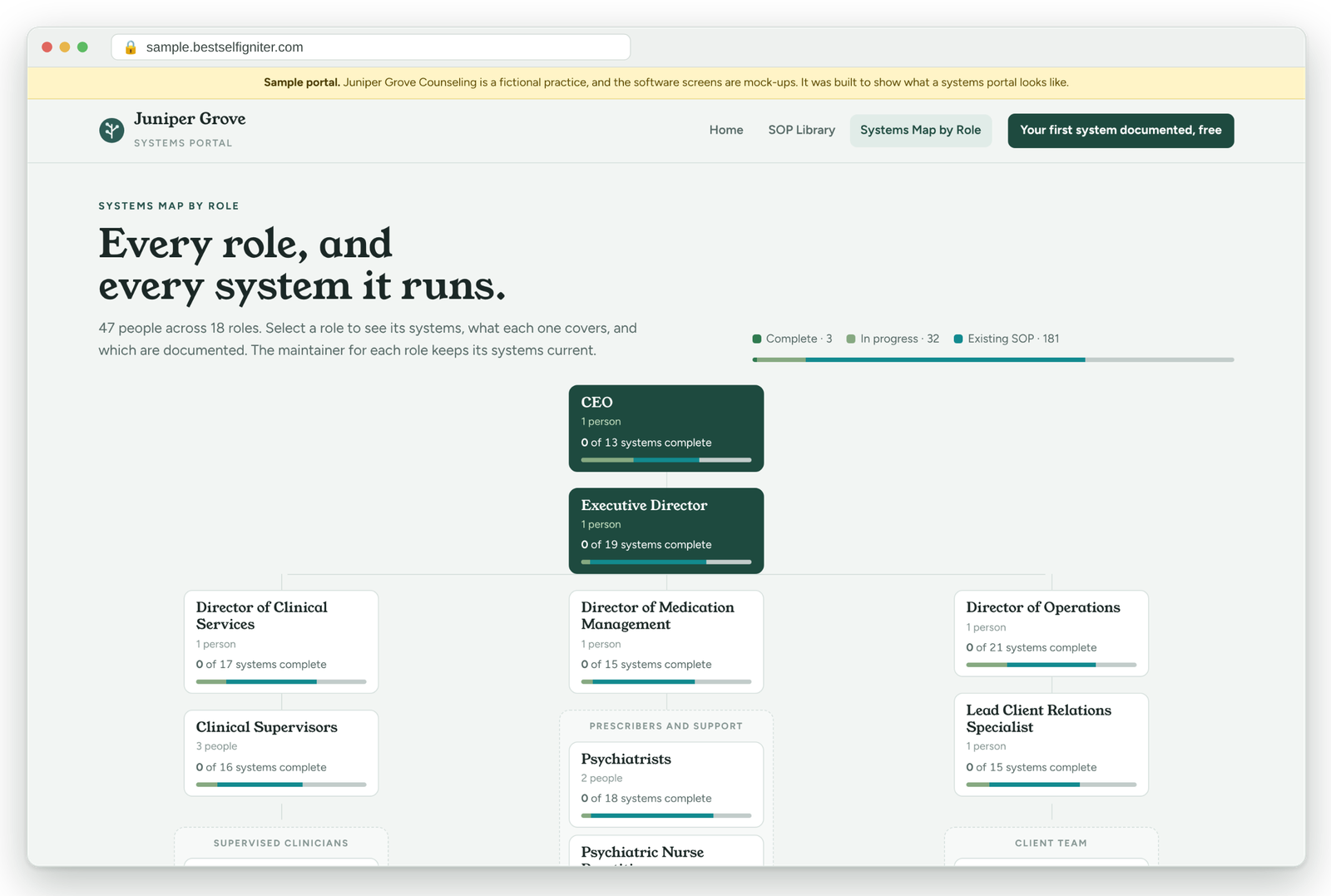
Every SOP comes as a clean document, and it can also live inside a simple portal the team or buyer can search and open anytime. Explore a sample built for Juniper Grove Counseling, a fictional therapy practice.
The Systems Map shows which role runs each system and which systems are still undocumented, so anyone reviewing the business can see at a glance where it depends on one person.
Juniper Grove is a sample practice. Every name and detail in it is fictional.

How this works
Step 1
We scope it to your deal. You tell me the target, the timeline, and what matters most for this transaction. We decide together which systems to document.
Step 2
I do the documenting. Most of the work is mine, through calls, screen recordings, and review of what already exists. For each system, the team’s part is a focused conversation and a quick review.
Step 3
You get deal-ready documentation. Clear SOPs and checklists a buyer or a combined team can rely on, handed over ready to use. Confidential throughout, and I’m glad to work under your NDA.

What documentation does for the deal
When the businesses in your deals are documented well, it creates:
A stronger valuation, because owner-dependence is one of the clearest things that discounts a business
Faster diligence, because the documentation a buyer requests is already in hand
Lower perceived risk, because the business doesn’t live in one person’s memory
A credible transition, because there’s a documented operating record to hand over
Knowledge that stays through integration, even as people move on
A combined business working from one documented way of operating, in the window when that clarity matters most
For deals with an earnout, a clearer path to the targets those first months are measured on
Documentation is one of the most controllable levers on how a business is valued and how cleanly it changes hands.
It’s one of the few a seller fully controls.

Who This Is For
This is a great fit if you are:
A sell-side advisor or broker who wants a client's business to show well and hold its value through diligence
A private equity or strategic acquirer who wants a target de-risked before close and integration-ready after
A roll-up or platform operator who needs each add-on documented and folded into one standard way of operating
An exit-planning or value-acceleration advisor preparing a founder for a stronger sale down the road
Not a fit if:
You want deal advisory, valuation, or integration consulting. I document how the business runs, alongside your deal team, not in place of it.
You want a generic template to download and fill in yourself
You need someone to manage long-term adoption inside the business after close (I can refer you if needed)
Frequently Asked Questions
-
That’s built into how I scope. Tell me the timeline and what matters most, and we’ll plan the work to fit it. For integration especially, I know the first months are the window that counts, so speed is part of the design.
-
Item description
-
It varies. Sometimes the seller funds it to get ready. Sometimes an advisor recommends it. Sometimes the acquirer funds it as part of preparing the target or integrating it. We’ll figure out what fits your situation.
-
It depends on how many systems we’re documenting. For a full pre-sale effort that covers many systems, it’s a meaningful commitment, though still far less than doing it themselves. Most of the work is mine. For each system, their part is a focused conversation and a review of the draft. When time is tight around a deal, we scope to the systems that matter most, so their hours go where they count.
-
No. I document how the business runs. I’m not an advisor, a banker, or an integration consultant, and I don’t step on the work your deal team does. I do one thing well, and I do it alongside them.
-
The work is usually remote, through calls, screen recordings, and review of existing material, which keeps it simple to schedule around a deal. If a situation calls for time on site, we’ll scope that together.
-
Always, including the fact of the transaction. I’m glad to work under your NDA.
-
Tools and templates still leave the hardest part to the business: knowing what to capture and putting it into words clear enough that someone else can follow. In a deal, that’s the whole game. I draw the process out of people’s heads, sharpen the fuzzy parts, and hand over documentation a buyer or a combined team can rely on.


Bring me into your next deal
The businesses in your deals are worth more, move faster, and integrate cleaner
when how they run is documented.
Let’s talk about where documentation would make the biggest difference in your deals.
If it’s useful, I’ll document one system at no cost so you can see the caliber first.
Or see it now in the sample portal.